Research
High-power semiconductor lasers
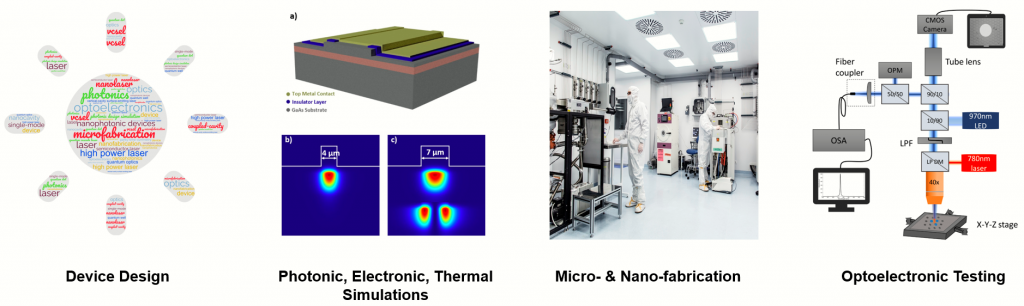
The deployment of high-power semiconductor lasers increased enormously in the past two decades to meet the needs of various industrial applications. Higher laser chip power is especially crucial for these systems. The root causes of power limitation have been studied to some extent, and novel approaches are needed to enhance the performance metrics of GaAs-based lasers. Our goal in this field is to find innovative solutions to the well-known problems of high-power lasers. In this direction, we work on novel methods to improve the efficiency, output power, and reliability of high-power semiconductor lasers.
Record high-power and high-efficiency semiconductor lasers

“High-power operation and lateral divergence angle reduction of broad-area laser diodes at 976 nm,” Optics & Laser Technology (2021).
“808 nm broad-area laser diodes designed for high efficiency at high-temperature operation,” Semicond. Sci. Technol. (2021).
Semiconductor Lasers Epitaxially-Stacked with a Tunnel Junction
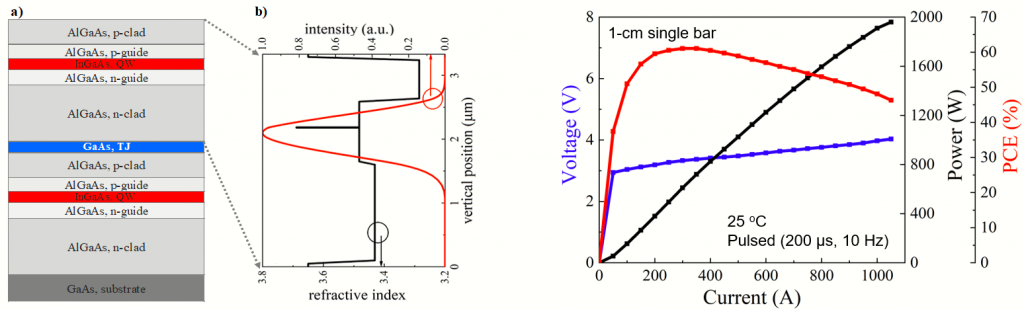
“High Efficiency 1.9 kW Single Diode Laser Bar Epitaxially Stacked With a Tunnel Junction,“ IEEE Photonics J. (2021).
Reliable semiconductor lasers
Catastrophic optical mirror damage (COMD) has been a long-standing issue for semiconductor lasers since their invention in the 1960s. COMD occurs when the laser facet reaches a critical temperature (Tc~120-160oC), leading to an irreversible failure of the device. Although GaAs-based semiconductor lasers have become an established technology and the most energy-efficient light source, their reliability and lifetime is still hindered by COMD. A solution to COMD hold significant implications for the semiconductor laser research community and industry, and beyond such as fiber and direct-diode lasers. Our research addresses a fundamental question: “Is it possible to create immortal semiconductor lasers?”
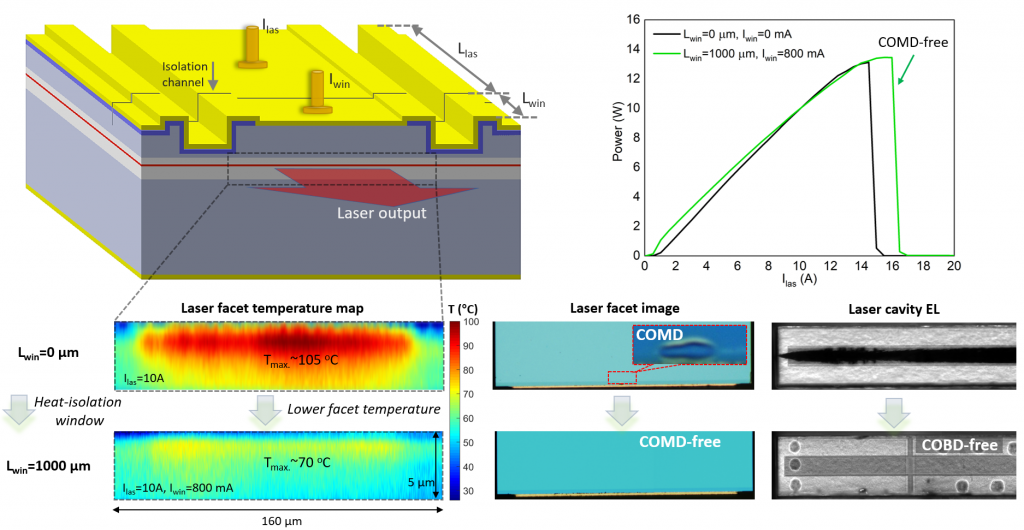
“Facet cooling in high power InGaAs/AlGaAs lasers,” IEEE Photon. Technol. Lett. (2019).
Lithographic Vertical-cavity surface-emitting lasers (Li-VCSEL)
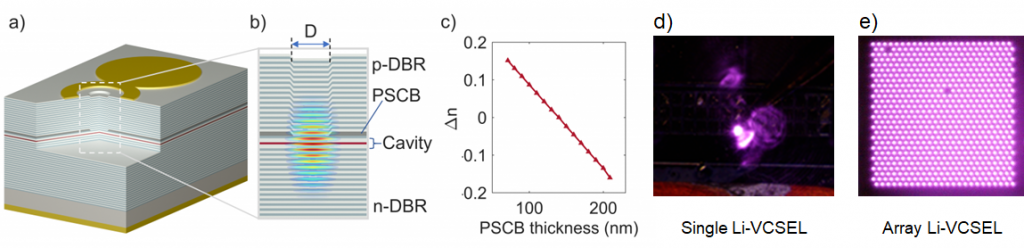
The microlaser method used in today’s industry is based on the oxide-VCSEL technology, in which wet oxidation provides optical and electrical confinement. Although this method has many successes with VCSELs, oxidation has many obstacles in terms of the performance of single and high-power VCSEL arrays. The structures required for the oxidation process limits the design of the laser and the density of the laser arrays, and the high heat resistance of the oxide reduces the laser performance. While these restrictions reduce the power, lifetime, brightness, and efficiency obtained from VCSELs, they also prevent new applications that may arise. The aim of the studies carried out within the project’s scope is to develop the lithographic-VCSEL (Li-VCSEL) method. This approach has the optoelectronic function provided by oxidation. In this method, which is based on the two-step growth of the VCSEL structure, we used a buried phase-shifting current-blocking (PSCB) epitaxial layer and the standard optical lithography method.
Micro- and nano-scale cavities and light sources
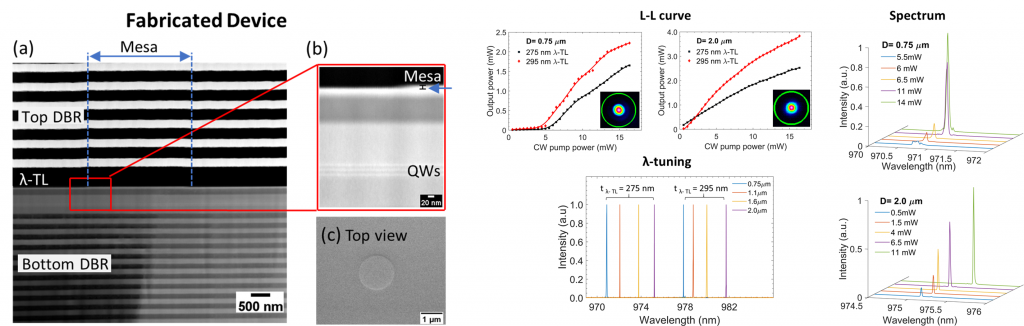
Vertical-cavity surface-emitting lasers (VCSELs) are highly desirable as light sources for optical data communication and 3D sensing due to their compact size, low power consumption, high-speed modulation, and affordability. To meet the growing demand for more energy-efficient high-speed devices, it is necessary to reduce the size of the cavities to near- or sub-wavelength dimensions. In this study, we employed the Li-VCSEL method to investigate wavelength-scale devices. We demonstrated lasing in Li-VCSELs with mesa diameters ranging from 0.75 to 2.0 μm at room temperature under continuous-wave optical pumping. These results show excellent optical confinement even for submicron sizes and represent a significant step towards realizing high-performance nanolasers. Moreover, the ability to tune the wavelength by adjusting the thickness of the λ-tuning layer while maintaining a high quality-factor is a valuable advantage for developing tunable VCSELs.
Parity-time symmetry in semiconductor lasers
High-power single spatial mode semiconductor lasers are of great interest in various applications, including optical communication, material processing, and single-mode fiber pumping. The output power of a typical index-guided ridge waveguide single-mode laser is limited by its narrow waveguide width, which is necessary to cut off higher-order optical modes. To overcome this output power limitation, conventional techniques rely on lateral mode discrimination in a single waveguide to enforce single-mode operation, which introduces loss for the fundamental optical mode as well. In contrast, our work leverages the concepts of parity-time symmetry (PTS) and quasi-PTS structures to achieve single-mode lasing in edge-emitting laser diodes with multi-mode waveguides. By utilizing these two approaches, we can overcome the limitations of conventional methods and enable high-power single-mode operation.

Quantum cascade laser (QCL)
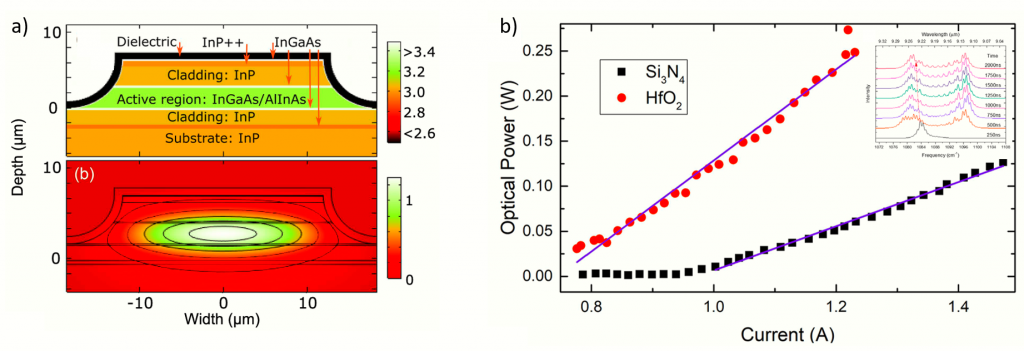
Quantum cascade lasers (QCLs) are coherent light sources that rely on intersubband transitions of multilayer semiconductor quantum well structures. They can be designed to emit light from short-wave infrared to terahertz frequencies. Intensive research has been done to achieve watt-level optical output powers at room temperature for mid- and long-wave IR wavelengths. We have shown that experimental loss for HfO2 passivated lasers is almost half that of the Si3N4 passivated lasers, and lasing threshold current densities are significantly reduced for QCLs with wavelength ~9 μm. HfO2 passivation could be a low-loss alternative to conventional QCL passivation materials and a low-cost alternative to regrowth leading to a significant increase in optical power output.